

When I started looking into low cost insurance trust options for elderly caregivers, I felt completely overwhelmed. My mom had just been diagnosed with early-stage dementia, and suddenly I was drowning in legal jargon, conflicting advice from well-meaning relatives, and a stack of bills that kept growing. If you’re caring for an aging parent or loved one right now, you already know that sinking feeling. The financial side of caregiving hits different when it’s personal. I want to share what I actually learned, because most of the advice out there misses the mark for people like us.
Why Elderly Caregivers Need Insurance Trusts in the First Place
Most caregivers don’t think about trusts until a crisis forces the conversation. I sure didn’t. But here’s what caught me off guard: without a trust, your loved one’s assets, including any life insurance policies, can get eaten alive by probate costs, Medicaid recovery claims, and estate taxes. For my family, that meant my mom’s small life insurance policy could have been completely wiped out before it helped anyone.
An irrevocable life insurance trust (ILIT) removes the policy from your loved one’s taxable estate. That’s huge. It means the death benefit goes directly to the beneficiaries you choose, not to creditors or the state. For caregivers who are already stretched thin financially, protecting even a modest payout makes a real difference. I learned this the hard way after watching a neighbor lose most of her late husband’s $50,000 policy to estate settlement costs.
The trick is finding options that don’t require a $5,000 attorney retainer just to get started.

Understanding the Types of Trusts That Actually Help Caregivers
Not every trust works for every situation, and some are flat-out unnecessary for families with modest assets. Here’s what I found most relevant after talking to three different estate planning attorneys and one really helpful financial advisor at my local credit union.
Irrevocable Life Insurance Trusts (ILITs)
This is the gold standard for protecting a life insurance policy. Once you transfer the policy into an ILIT, it’s no longer part of the estate. The trust owns the policy, a trustee manages it, and the proceeds pass to beneficiaries tax-free. The downside? You give up control. You can’t change beneficiaries or borrow against the policy once it’s in the trust. For my mom’s situation, this was the right call because her policy was small and she had no plans to touch it.
Medicaid Asset Protection Trusts
If your loved one might need Medicaid to cover nursing home costs, this type of trust can shelter certain assets. The catch is the five-year lookback period. Anything transferred into the trust within five years of applying for Medicaid can be counted against eligibility. So timing matters enormously. I wish someone had told my family about this sooner, because we started the process about three years before my mom needed full-time care, which was cutting it close.

Revocable Living Trusts
These are simpler and cheaper to set up, but they don’t protect assets from Medicaid or creditors. They mainly help avoid probate. For caregivers managing an elderly person’s finances, a revocable living trust can simplify things during incapacity. But if asset protection is your main goal, this isn’t the answer on its own.
Low Cost Insurance Trust Options for Elderly Caregivers on a Budget
Here’s where things get practical. Because let’s be honest, most caregivers aren’t sitting on piles of extra money.
Online legal platforms like LegalZoom, Trust & Will, and Nolo offer trust creation tools starting around $159 to $499. I used Trust & Will for my mom’s revocable trust and paid $399. The process took about two hours, and the documents were reviewed by a licensed attorney in our state. For a basic ILIT, though, I’d recommend at least a one-time consultation with a local estate planning lawyer because the funding and administration details get tricky.
Some nonprofit organizations also offer reduced-cost legal help for elderly individuals. The Eldercare Locator (run by the U.S. Administration on Aging) connected me with a local legal aid office that charged on a sliding scale. My mom qualified for a reduced rate, and we paid $200 for a consultation that would have cost $500 elsewhere.
Law school clinics are another underrated resource. Several universities run estate planning clinics where supervised law students prepare trust documents at little or no cost. I found three options within driving distance of my mom’s house through the American Bar Association’s website.

How to Choose the Right Insurance Trust When Money Is Tight
Picking the right trust really comes down to three questions I kept asking myself:
First, what are you trying to protect? If it’s just a life insurance policy, an ILIT is probably your best bet. If you’re trying to preserve a home or savings for Medicaid purposes, you need a Medicaid asset protection trust instead.
Second, how much time do you have? The five-year Medicaid lookback period means planning ahead saves money. Starting early gives you cheaper, simpler options. Waiting until a health crisis hits limits your choices and often costs more in legal fees because everything becomes urgent.
Third, what’s the total value of the estate? For estates under the federal estate tax exemption (currently $13.61 million per individual in 2024), you probably don’t need a complex trust structure. A simple ILIT or revocable trust handled through an online platform might cover everything. I see families overpay for elaborate trust packages they don’t need, and it frustrates me every time.
Real Costs I Encountered Along the Way
I want to be transparent about what I actually spent, because vague advice about “affordable” options never helped me.
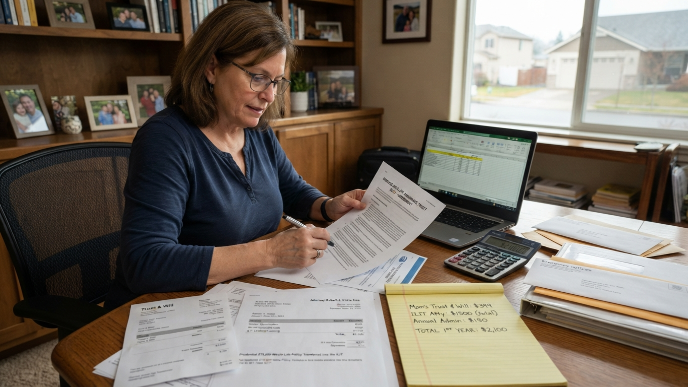
Setting up my mom’s revocable living trust through Trust & Will cost $399. The one-time attorney consultation to discuss ILIT options ran $350 for a 90-minute session. The attorney quoted $1,200 to draft and fund the ILIT, which included transferring her $75,000 whole life policy into the trust. Annual trust administration (filing Crummey notices, which are required for ILITs) costs about $150 per year if I handle the paperwork myself using templates the attorney provided.
Total first-year cost: roughly $2,100. That’s real money for a caregiver, but compare it to the potential loss of the entire $75,000 policy to estate costs or Medicaid recovery. The math worked in our favor.
Some families spend less. If you use a legal aid clinic and handle a smaller policy, you might get everything done for under $800. The key is shopping around and not accepting the first quote you receive.
Common Mistakes Caregivers Make With Insurance Trusts
I made some of these myself, so no judgment here.
Waiting too long is the biggest one. Every estate planning attorney I spoke with said the same thing: families show up after a diagnosis, after a hospitalization, after the person has already lost capacity to sign documents. By then, options shrink and costs go up. If your loved one can still make legal decisions, start the conversation now.
Naming yourself as both trustee and beneficiary of an ILIT creates tax problems. The IRS can pull the policy back into the taxable estate. I almost made this mistake because it seemed logical to keep things simple. My attorney caught it and suggested naming a trusted family friend as trustee instead.
Forgetting to actually fund the trust is surprisingly common. You can have a perfectly drafted ILIT sitting in a file cabinet, but if nobody transfers the insurance policy into it, the trust does nothing. The funding step is separate from the drafting step, and people skip it more than you’d think.
Working With Medicaid Planning and Insurance Trusts Together
For many elderly caregivers, Medicaid planning and insurance trust planning overlap. My mom’s situation required both. Her whole life policy needed protection via an ILIT, and her modest savings needed sheltering through a Medicaid asset protection trust to preserve eligibility for long-term care coverage.
A Medicaid planning attorney (sometimes called an elder law attorney) can coordinate both strategies. The National Academy of Elder Law Attorneys (NAELA) has a directory on their website where you can search by state. I found our attorney there, and she charged less than the general estate planning firms I’d contacted first because elder law was her specialty.
One thing that surprised me: some states treat insurance trust proceeds differently for Medicaid purposes. In my mom’s state, the ILIT proceeds were completely exempt from Medicaid estate recovery. In other states, the rules are stricter. Always confirm your state’s specific regulations before assuming anything.
When a Trust Isn’t the Right Answer
Trusts aren’t magic. For some families, they’re unnecessary overhead.
If your loved one has no life insurance policy, minimal assets, and will rely entirely on Medicaid, the cost of setting up an ILIT doesn’t make sense. The money is better spent on direct care needs. A simple will and a durable power of attorney might be all you need.
Similarly, if the person you’re caring for is already on Medicaid and past the lookback period, creating a new trust won’t change their eligibility status. At that point, you’re better off focusing on maximizing the benefits they already qualify for.
I talked to one caregiver in my support group who spent $3,000 on a trust package for her father’s $10,000 term life policy. The policy had no cash value, and the death benefit was small enough that probate costs would have been minimal anyway. That money could have gone toward home modifications or respite care instead.
FAQs
What is the cheapest way to set up an insurance trust for an elderly family member?
Online platforms like Trust & Will and LegalZoom offer basic trust documents starting around $159 to $499. For ILITs specifically, combining an online platform for the initial documents with a single attorney consultation (usually $250 to $400) keeps costs down while ensuring the trust is properly structured for your state’s requirements.
Can I set up an ILIT if my parent already has dementia?
The person whose policy is being transferred must have legal capacity to sign documents. If dementia has progressed past that point, you’ll need an existing power of attorney that grants authority over insurance and estate matters. Without that, a court-appointed guardianship may be required, which adds significant cost and time.
Are there low cost insurance trust options for elderly caregivers with very small policies?
Yes, but weigh the cost against the benefit. For policies under $25,000, the expense of creating and maintaining an ILIT might not be justified. A simpler approach, like naming beneficiaries directly on the policy and using a payable-on-death designation, can avoid probate without the trust overhead.
How long does it take to set up an irrevocable life insurance trust?
From start to finish, expect four to eight weeks. Drafting the trust document takes one to two weeks. Transferring the policy into the trust requires coordination with the insurance company, which can take another two to four weeks. Don’t wait until a health emergency to start this process.
Does an ILIT affect Medicaid eligibility?
Generally, assets inside a properly structured ILIT are not counted for Medicaid eligibility purposes. However, the five-year lookback period applies to the transfer. If you move a policy into an ILIT within five years of applying for Medicaid, the transfer could trigger a penalty period. Timing is everything here.
Conclusion
Figuring out how to protect your loved one’s assets while managing caregiving responsibilities is genuinely hard, and nobody prepares you for how emotional the financial decisions feel. Start with the simplest option that fits your situation, talk to at least one elder law attorney before signing anything, and don’t let anyone pressure you into a trust package you can’t afford. What’s been your biggest challenge with planning for an aging parent’s finances?
